
I. Breve Visão Geral da Arquitetura Subjacente da IMU
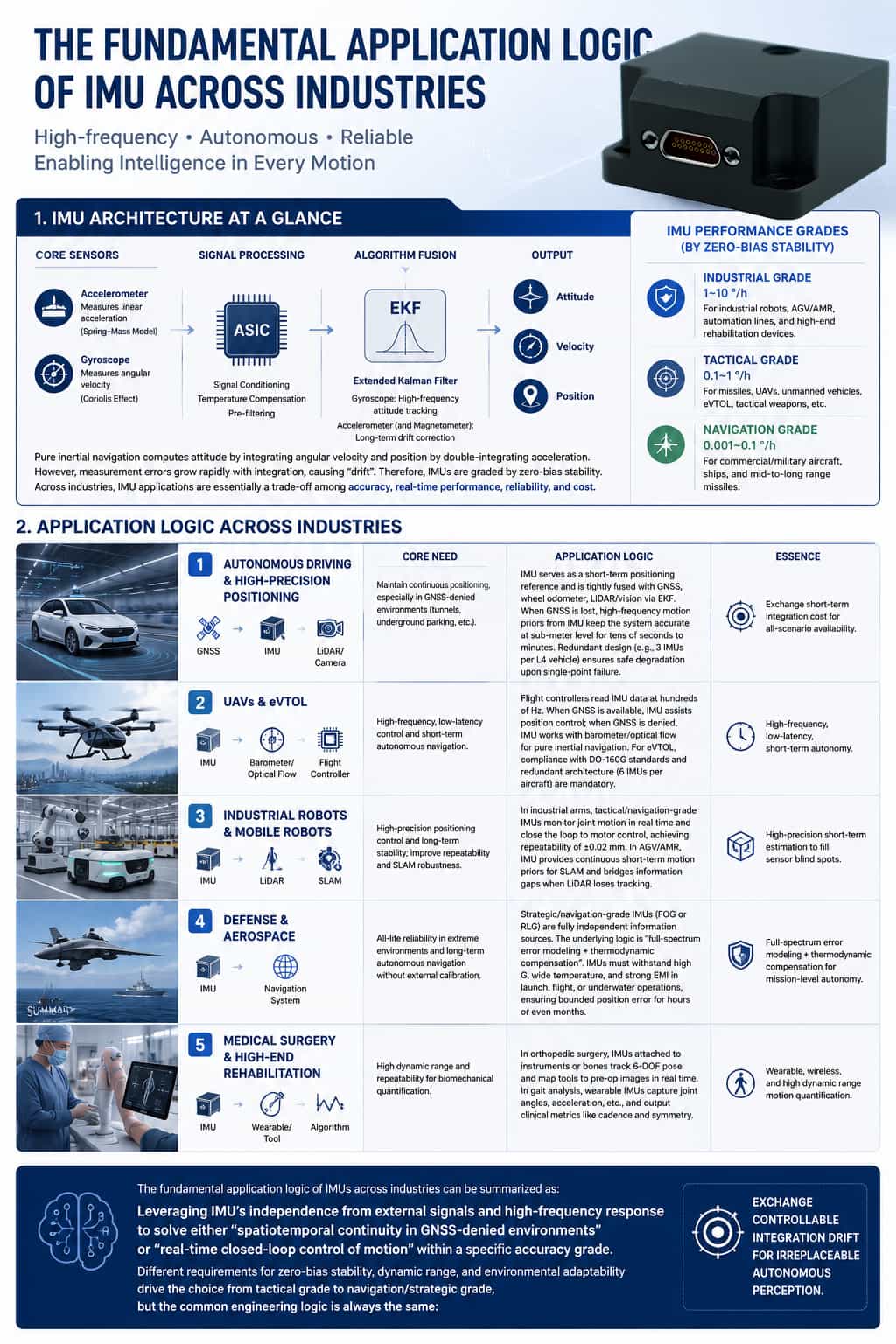
O hardware principal de uma Unidade de Medição Inercial (IMU) consiste em acelerômetros e giroscópios, que medem a aceleração linear e a velocidade angular, respectivamente. IMUs de nível industrial e superior normalmente empregam tecnologia MEMS, enquanto unidades de ponta utilizam giroscópios de fibra óptica ou a laser, combinados com ASICs dedicados para realizar condicionamento de sinal, compensação de temperatura e filtragem preliminar. Os acelerômetros são baseados em um modelo de "massa-mola" — onde o deslocamento de uma massa de prova reflete a aceleração; os giroscópios aproveitam o efeito Coriolis — onde uma massa vibrante gera uma deflexão mensurável quando submetida à rotação. No nível algorítmico, o Filtro de Kalman Estendido (EKF) funde esses dois fluxos de dados: o giroscópio fornece rastreamento de atitude de alta frequência, enquanto o acelerômetro (juntamente com o magnetômetro) realiza a correção de longo prazo para a deriva. A navegação inercial pura deriva a atitude integrando a velocidade angular e a posição integrando a aceleração duas vezes; No entanto, os erros de medição se amplificam rapidamente a cada ordem de integração, resultando em "deriva". Consequentemente, as IMUs são normalmente classificadas em graus com base na estabilidade de seu viés:
1) Grau Industrial (Estabilidade de Desvio: 1–10°/h): Adequado para cenários dinâmicos de curta duração — como robôs industriais, AGVs/AMRs, linhas de produção automatizadas e equipamentos de reabilitação de alta tecnologia — onde há uma exigência moderada de estabilidade a longo prazo, mas uma sensibilidade significativa ao custo.
2) Grau Tático (0,1–1°/h): Adequado para aplicações que exigem alta resposta dinâmica e navegação autônoma de curta duração, como mísseis, UAVs, veículos terrestres não tripulados, aeronaves eVTOL e armamento tático.
3) Grau de Navegação (0,001–0,1°/h): Adequado para missões que exigem navegação autônoma por períodos médios (variando de dezenas de minutos a várias horas) sem calibração externa, como aquelas que envolvem aeronaves comerciais ou militares, navios e mísseis de médio a longo alcance.
Compreendendo essa arquitetura subjacente, a lógica de aplicação das IMUs em diversos setores torna-se clara: fundamentalmente, envolve fazer concessões distintas entre "precisão, desempenho em tempo real, confiabilidade e custo". II. Lógica de Aplicação Subjacente em Diversos Setores
1. Condução Autônoma e Posicionamento de Alta Precisão
Em cenários de condução autônoma e posicionamento de alta precisão, o requisito fundamental é alcançar um posicionamento contínuo, especialmente em ambientes sem sinal de GPS, como túneis e estacionamentos subterrâneos. A lógica da aplicação envolve a utilização da IMU (Unidade de Medição Inercial) como uma base confiável para posicionamento de curto prazo. Esses dados são combinados com informações de GNSS (Sistema Nacional de Sinalização Geodésica), odômetros de rodas e sistemas de visão/LiDAR por meio de filtragem de Kalman acoplada. Ao aproveitar as informações de movimento de alta frequência fornecidas pela IMU (especificamente velocidade angular e aceleração), o sistema consegue manter a estimativa de posição com precisão submétrica por períodos que variam de dezenas de segundos a vários minutos, mesmo após a perda do sinal de GPS. Simultaneamente, por meio de um projeto redundante (por exemplo, equipando um único veículo autônomo de Nível 4 com três IMUs), o sistema garante uma degradação segura do desempenho em caso de falha em um único ponto. A lógica fundamental aqui é trocar o custo da deriva de integração de curto prazo pela disponibilidade em todos os cenários.
2. Drones e eVTOLs
Em cenários com drones e eVTOLs, os sistemas de controle de voo leem dados de velocidade angular e aceleração da IMU em frequências de várias centenas de Hertz, utilizando um mecanismo de controle PID em malha fechada para ajustar a velocidade dos motores em tempo real. Quando os sinais de GPS são robustos, a IMU auxilia no controle de posição; no entanto, em ambientes sem GPS (como em ambientes internos ou em cânions), a IMU se combina com barômetros ou sensores de fluxo óptico para entrar em um modo de navegação puramente inercial. Para aeronaves tripuladas, como eVTOLs, requisitos adicionais incluem a conformidade com os padrões de aeronavegabilidade (por exemplo, DO-160G) e a adoção de arquiteturas redundantes (por exemplo, equipar uma única aeronave com seis IMUs). A lógica central nesse contexto é caracterizada por "alta frequência, baixa latência e autonomia de curto prazo".
3. Robôs Industriais e Robôs Móveis
Os principais requisitos para robôs industriais e robôs móveis são o controle preciso de posição e a estabilidade a longo prazo, visando aprimorar a precisão do posicionamento repetitivo e a robustez dos sistemas SLAM (Localização e Mapeamento Simultâneos). Em braços robóticos industriais, IMUs (Unidades de Medição Inercial) de nível tático ou de navegação monitoram as trajetórias de movimento de juntas individuais em tempo real, fornecendo correções em malha fechada aos comandos dos motores para alcançar uma precisão de posicionamento repetitivo de ±0,02 mm. Em AGVs (Veículos Guiados Automaticamente) e AMRs (Robôs Móveis Autônomos), a IMU fornece ao sistema SLAM informações prévias contínuas de movimento em curto prazo; quando os sistemas LiDAR falham devido a campos de visão ocluídos ou características ambientais insuficientes, os dados integrados da IMU "preenchem" essas lacunas de informação, mantendo assim a continuidade da estimativa de pose. A lógica fundamental aqui é "estimativa de alta precisão em curto prazo para preencher os pontos cegos dos sensores". 4. Defesa e Aeroespacial
Os principais requisitos nos setores de defesa e aeroespacial são a confiabilidade ao longo de todo o ciclo de vida em ambientes extremos e capacidades de navegação autônoma que funcionem por longos períodos sem calibração externa. As IMUs de nível estratégico (ou de nível de navegação) — que normalmente utilizam giroscópios de fibra óptica ou a laser — são projetadas para servir como fontes de informação completamente independentes. Sua lógica subjacente baseia-se em uma combinação de "modelagem de erro de espectro completo" e "compensação termodinâmica". Durante fases críticas, como lançamento, voo ou submersão subaquática, essas IMUs devem suportar altas forças G, amplas flutuações de temperatura e intensa interferência eletromagnética; simultaneamente, por meio de especificações excepcionalmente precisas de estabilidade de polarização e caminhada aleatória, elas garantem que os erros de posicionamento permaneçam limitados por períodos que abrangem horas ou até meses. Além disso, a produção nacional e a autonomia tecnológica tornaram-se imperativos absolutos nesse campo.
5. Cirurgia Médica e Reabilitação de Alta Complexidade
Os principais requisitos em cirurgia médica e reabilitação de alta complexidade são uma ampla faixa dinâmica e alta repetibilidade na quantificação de parâmetros biomecânicos. Na navegação cirúrgica ortopédica, as IMUs (Unidades de Medição Inercial) são fixadas aos instrumentos cirúrgicos ou à estrutura esquelética do paciente; utilizando o rastreamento de pose com seis graus de liberdade (6-DOF), elas mapeiam a posição em tempo real dos instrumentos em imagens médicas pré-operatórias. A lógica subjacente é aproveitar a precisão de curto prazo das IMUs de nível tático para contornar os problemas de sensibilidade à oclusão inerentes aos sistemas de navegação óptica. Na análise da marcha, as IMUs são utilizadas nos membros para capturar parâmetros como ângulos articulares e aceleração; esses dados são então processados por meio de algoritmos de fusão de sensores para gerar métricas clínicas como frequência de passos e simetria da marcha. Fundamentalmente, essa aplicação representa "quantificação de movimento vestível, sem fio e de alta faixa dinâmica".
Resumo
A lógica fundamental de aplicação das IMUs em diversos setores pode ser resumida da seguinte forma: aproveitar suas vantagens inerentes — especificamente sua independência de sinais externos e suas capacidades de resposta em alta frequência — para solucionar o "problema da continuidade espaço-temporal em ambientes sem GPS" ou o "problema do controle em tempo real em malha fechada de estados de movimento", tudo dentro de um nível específico e necessário de precisão. Os diferentes requisitos em cada setor — em relação à estabilidade do viés, faixa dinâmica e adaptabilidade ambiental — ditam a seleção específica das IMUs, que variam de dispositivos de nível tático a dispositivos de nível estratégico. Contudo, a lógica de engenharia compartilhada que sustenta todas essas aplicações permanece constante: equilibrar um grau controlável de deriva de integração em troca de uma capacidade indispensável para a consciência situacional autônoma.
Deixe um recado
Escaneie para o WeChat :